
Newton County VINE Coverage
Georgia VINE is a statewide custody-status and notification service. It can carry a Newton County jail, prison, or agency record when that record is available through the participating feed. The service is designed for a person-specific check and a status-change alert. It is not a complete list of everyone released from Newton County Jail, and it does not replace the official release record.
The Newton County Sheriff's Office separately links to OffenderIndex. That local search distinguishes current inmates, recent bookings, booking-date searches, and previous inmates. Use it beside VINE. A current county listing supports active local custody, while a prior record or missing current result needs confirmation through VINE, the court docket, or sheriff records.
State-prison cases belong to the Georgia Department of Corrections. Compare a VINE result for a state prisoner with the GDC offender search. Federal prisoners belong in the Bureau of Prisons locator, not VINE. Immigration custody uses ICE's locator when there is a real immigration-custody reason.
VINE also differs from Georgia's sex offender registry. The registry covers only people subject to registration law and is not a general Newton County release list. A VINE search tracks a known custody record and alert options. A registry search addresses a separate statutory duty after release. Keeping those purposes apart prevents a limited registry result from being treated as a broad custody answer.
Search a Newton County Inmate on VINE
Start at the official Georgia portal. Gather the person's full name and any known ID, age, date of birth, facility, or case detail before searching. Common names can return unrelated people, and spelling can differ across booking systems.
- Open Georgia VINE and select the current person or offender search.
- Enter the person's name or available ID. If the interface offers partial-name searching, use it when exact spelling fails.
- Compare age, date of birth, facility, custody status, and other identifiers before choosing a result.
- Open the details and read the status wording exactly. Note whether the record points to Newton County Jail, GDC, or another agency.
- If release or transfer appears, confirm it with the sheriff, GDC, or court source that owns the record.
If no record appears, change only what the known facts support. Check a maiden name, alias, or spelling variant. Then use the Newton County released-inmate search paths to decide whether the sheriff, court, GDC, BOP, or ICE is the right custodian.
The sheriff's “Bookings Made in the Last 24 Hours” view is an intake tool, not a release feed. A person can appear there and remain held. The “Include Previous Inmates In Search” option is more useful after a person drops from Current Inmates, yet it still does not state why custody ended. VINE can supply a status-change clue while the sheriff release record supplies the reason.
Newton VINE Release Record Fields
Fields vary with the agency feed. Describe only what appears in the selected record. A VINE result may show that the person remains in custody, has moved, or is no longer held. Some records may include a date or an agency label, while others provide less detail.
| Field | What it can show |
|---|---|
| Name or offender ID | Helps match the result to the intended person. |
| Custody status | Indicates the status sent by the participating agency. |
| Facility or agency | Identifies which jail, prison, or authority supplied the record. |
| Release or change date | May identify when a reported status event occurred. |
| Notification option | Shows whether the record currently permits alert registration. |
A released result may say the person is no longer in custody, give a release date, or stop offering some custody alerts. It is not the same as a court disposition. Bond release does not end the case. Transfer also ends custody at one facility without placing the person in the community.
Register for Newton County Release Alerts
Registration begins inside the matched record. The current interface controls which methods are available. Georgia's statewide service supports access by phone, online, and mobile app, while a record may offer phone, email, text, TTY, app, or another current method.
- Select “Get Notified” or the notification choice shown on the person's VINE record.
- Add one or more contact methods offered by the interface. Check every entry for typing errors.
- Follow the prompt for a PIN, code, or account confirmation. Phone alerts often use a PIN to acknowledge receipt and stop repeat calls.
- Complete registration and retain the confirmation details without sharing the PIN or personal contact data.
- Keep the sheriff or GDC source at hand so an alert can be checked against the official agency record.
Choose a PIN that can be recalled but not guessed. VINE prompts may change, so follow the live instructions instead of relying on a sample code. When more than one contact method is allowed, using two can reduce the chance that a missed call or filtered message prevents notice.
Registration is tied to the selected person and record. If the person later moves between local and state custody, confirm that the active record and alert choice still match the right agency. Save the registration confirmation, but do not share contact details or the PIN. A direct check remains useful when an expected notice does not arrive.
Confirm Newton VINE Release Alerts
VINE can lag, omit a record, or display only the status supplied by a participating source. A missing result can reflect spelling, an update delay, a nonparticipating record, release outside the visible status window, or custody in another system. It is not proof that no custody event occurred.
For Newton County Jail, check the sheriff-linked search and request the booking and release record when needed. The sheriff record can document date, time, reason, bond, transfer, or hold notation. For a state prisoner, use the GDC offender search for status, facility, sentence, and release fields when available.
For a federal prisoner, use the BOP locator. The federal system can show release information for prisoners from its covered period and warns that dates can change during recalculation. ICE has its own detainee locator. Neither source should be mixed with an ordinary Newton County jail release unless the facts point to that custody type.
Georgia's Newton Notification Layer
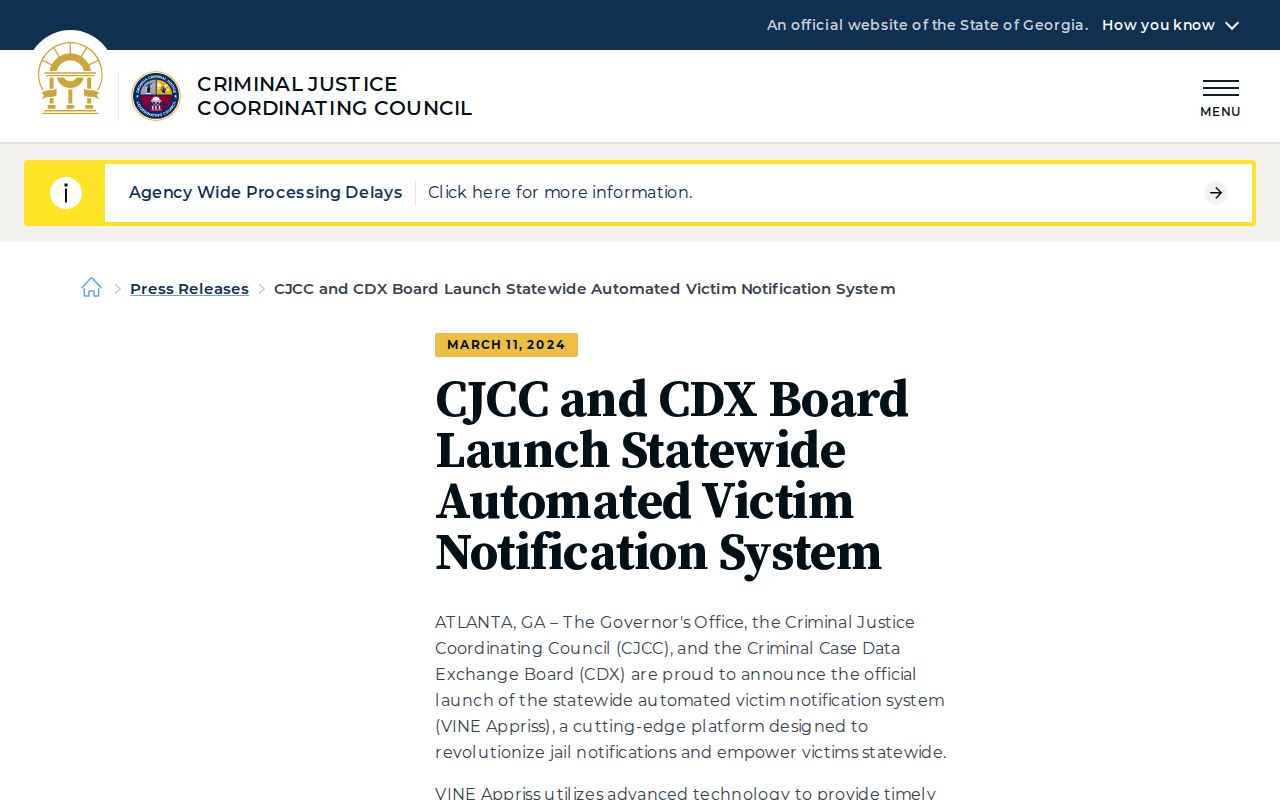
Georgia's Criminal Justice Coordinating Council and Criminal Justice Data Exchange Board announced the statewide automated victim-notification service as a real-time status-change system. The announcement describes access by phone, online, and mobile app. That statewide layer gives Newton County users another channel beyond the sheriff's web roster.
The official Georgia notification announcement explains the service and its access channels.
The state system does not turn VINE into a Newton County court or jail archive. Its strongest role is timely status awareness for a known person. The Sheriff remains the source for local booking and release records, GDC remains the state-prison source, and the court remains the source for the case outcome.
When Newton VINE Finds Nothing
A no-result screen calls for a source check, not a conclusion. First verify the name and ID. Next ask which agency could hold the person. A Newton County current inmate belongs in the sheriff-linked search. Someone transferred after sentencing belongs in GDC. A federal or immigration case needs its own federal locator.
- Current jail roster
- A live list used to confirm active Newton County Jail custody, not a complete released-person archive.
- Previous-inmate search
- The OffenderIndex option that may preserve a prior Newton County booking after the current listing drops away.
- Custody notification
- A VINE alert about a participating record's release, transfer, or status change.
- Release record
- The agency document that confirms when and why custody ended or moved.
Use the Newton County Clerk's case search when the question concerns bond, sentence, dismissal, or another court action. Court records can outlast a jail stay. If the online sources disagree, preserve the exact status wording and contact the record custodian rather than choosing the result that seems most recent.
A sheriff open-records request can ask for the booking and release record for a named person and known booking date. Request the release date and time, release reason, and any bond, hold, or transfer notation. The court docket is the better source for the case outcome. GDC is the better source after transfer to a state sentence. Routing the request correctly is often faster than repeating the same VINE search.
Newton Released Versus In Custody
A current roster entry supports present jail custody. A VINE in-custody status supports the participating agency's current feed. A released status is a notice that custody changed, but it does not explain whether the person bonded out, completed time, transferred, entered parole, or moved under another hold.
| Question | Primary path | Follow-up |
|---|---|---|
| Still in Newton jail? | OffenderIndex Current Inmates | Confirm with the Sheriff's Office |
| Recently left Newton jail? | VINE and previous-inmate search | Request the sheriff release record |
| Transferred to state custody? | GDC offender search | Compare facility and sentence data |
| Case status after release? | Newton County court search | Read the docket or order |
| Federal custody? | BOP inmate locator | Use the federal record |
These paths prevent a common error: treating disappearance from the live jail list as proof of community release. A person can transfer to GDC, another county, federal custody, or another authority. The release reason and receiving agency settle that question.
Timing matters when systems update at different speeds. Save the exact VINE status and the time it was seen, then compare it with the live agency record. Do not infer a release hour that VINE does not show. If a notice reports transfer, identify the receiving agency before deciding which search to use next. A GDC match points to state custody, while a later Newton County court entry may explain the sentence or order behind that move.
For a bond event, the sheriff's Bond Process material distinguishes cash, property, bonding-company, transfer, and city bonds. Those local categories explain how jail custody can end, but bond is not a finding that the criminal case ended. The clerk's docket remains the source for later disposition. VINE may report a custody change without giving that full legal context.
A person already released to parole belongs in the Parole Board's parolee search and DCS supervision system. A person still awaiting parole review may have a Tentative Parole Month, which the Board says is not a final release date. VINE can notify when a participating custody status changes, but it cannot turn a tentative review month into a guaranteed exit. Confirm the completed state release with GDC and the Board record.