
Newton Projected and Actual Release
A projected date is a calculation or a planned point in a sentence. It is not proof that someone has left custody. The actual release is the completed event recorded by the agency that held the person. In Newton County Jail, that event might be a bond release, time served, dismissal, court order, transfer, or the end of a local sentence. A transfer means county custody ended, but the person may still be confined by GDC or another agency.
Pretrial custody works differently. A person waiting for a case outcome does not have a sentence from which staff can compute an end date. Bond action, a commitment hearing, a court order, or a hold may control the timing. The sheriff-linked jail search can show present or prior booking information, while the Newton County court docket supplies the case action. Neither an estimated date nor absence from the current roster alone confirms community release.
Find a Newton County Release Date
Begin with custody type, not with a single statewide search. Newton County Jail holds local detainees and some locally sentenced people. GDC holds state prisoners. The State Board of Pardons and Paroles controls parole decisions, and the Department of Community Supervision handles community supervision. Each source answers a different part of the date question.
- Check the Newton County jail search for current custody or a previous booking. If the person remains a local detainee, compare the booking with the court case.
- Use the Newton Clerk of Superior Courts case search for a sentence, bond order, dismissal, or later case action that may control release.
- If the person was sentenced or transferred to state prison, search the GDC Find an Offender portal. Compare identity, status, facility, sentence, and release fields.
- For parole timing, consult the Board's TPM lookup. For a person already released on parole, use the parolee search and local supervision record.
- When the online record is unclear, ask the Newton County Sheriff's Office for the jail release calculation or record. Ask GDC about a state sentence.
The broader Newton County released-inmate lookup explains how jail, court, and state records work together after custody ends. Name-only results need care. Match age, case number, offense, and known facility before relying on a date.
For a jail calculation, request the precise record that answers the question. Give the person's full name, known booking date, and case number, then ask for the release date or local sentence calculation and any hold or transfer notation. A narrow request helps the Sheriff's Office locate an existing record. For a court question, use the clerk because court documents are maintained by the applicable Clerk of Court, not by the county's general open-records office.
Newton County Release Date Computation
Georgia rule 125-2-4 separates a sentence begin date from a sentence end date. The begin date is the effective start of the sentence and can reflect jail time already served or special sentencing directions. The end date is based on the maximum sentence, non-running time, and earned-time credits. “Non-running time” is time that does not count toward completion under the applicable record, so it can push an end date later.
Credits do not create one simple formula for all Newton County cases. A state record may change when jail credit is corrected, a sentence is amended, credits are earned or forfeited, or time stops running. Local jail calculations also turn on the court sentence, jail credit, holds, and time-served language. A short county sentence may never produce a GDC projected date because GDC is not the custodian.
Georgia also should not be summarized as a universal 85-percent state. The Parole Board uses crime severity, risk, eligibility rules, and its own judgment for eligible cases. O.C.G.A. § 17-10-6.1 imposes special rules for serious violent offenses. Some sentences have mandatory or restricted parole treatment, while other eligible cases receive guideline review. The exact judgment and agency record control.
Life sentences involving serious violent felonies have separate historical rules. The Board's materials distinguish offenses by when they occurred, including different review points for pre-1995 cases, changes beginning in 1995, and later offenses. Those rules belong to a state parole analysis and should never be applied to a short Newton County jail sentence. The judgment date and offense classification are vital before any eligibility estimate is repeated.
Why Newton Release Dates Move
A date can move earlier or later after the first public result appears. The reason may lie in the sentence record, a separate agency hold, institutional conduct, or parole action. The relevant custodian must confirm which factor applies.
| Factor | Possible effect | Best source |
|---|---|---|
| Jail credit or sentence correction | Changes the effective start or end calculation | Court order and GDC or jail record |
| Earned credit or forfeiture | May shorten or extend computed confinement | GDC sentence record |
| Detainer or agency hold | May prevent community release or cause transfer | Newton jail and receiving agency |
| New court order | May alter bond, sentence, or release authority | Newton County court docket |
| Parole review | May deny parole, set timing, or require conditions | State Parole Board |
| Residence plan | Can delay parole while an acceptable plan is verified | Parole Board and DCS |
A detainer is a request or hold from another authority. It can cause a person to leave Newton County Jail for another jail, GDC, federal custody, or immigration custody. That is a local release in the narrow sense, but it is not freedom from custody.
Confirm a Newton Release Date
For a county release, ask the Newton County Sheriff's Office for the booking and release record, including date, time, reason, and any transfer or hold notation. The Sheriff's open-records channel is the online records-request page. Georgia's Open Records Act allows access to existing public records subject to exemptions, but an agency does not have to create a special calculation or list that it does not maintain.
For a state prisoner, compare the GDC offender result with the sentence and any parole record. GDC describes its public tool as a way to locate facility, charges, and release-date information, though not every field appears in every record. A completed state release may show a release date or changed status. A current facility entry points to continuing custody.
Georgia VINE can add an alert when a participating record is available. The Newton County VINE inmate check covers person-by-person searching and notification registration. VINE is an alert layer, not the controlling court or corrections record, so confirm its message with the sheriff, GDC, or court.
Three Newton County Release-Date Systems
The same phrase can point to three unlike records. A Newton County jail date comes from a local bond, sentence, court order, or transfer event. A GDC sentence-end date comes from state sentence administration. A Tentative Parole Month comes from the Parole Board's review process. Mixing them can turn a useful clue into a false promise.
- County jail release
- The date local jail custody ends through bond, time served, dismissal, sentence completion, transfer, or hold resolution.
- Sentence end date
- A GDC sentence-administration field based on maximum sentence length, non-running time, and earned credits.
- Tentative Parole Month
- The month when the Board expects final parole review, not a grant or fixed exit date.
- Actual release
- The completed departure or transfer recorded by the agency that held the person.
A bonded Newton County defendant may have no sentence-end date at all. A person with a GDC date may not have a TPM. Someone with a TPM may still face final review, conduct requirements, program conditions, or residence-plan verification. Read the label exactly as the agency presents it.
Newton County TPM Is Not Release
The State Board of Pardons and Paroles states that a TPM is not a final parole decision. It identifies a month for final review. If release is appropriate, the Board may then set a parole release date. Good conduct and program completion can matter, while misconduct can postpone or cancel the tentative month. The Board may also accept or reject its guideline recommendation.
The Board's TPM explanation is the source for this distinction. The Board's guidelines use a months-to-serve or percentage recommendation based on crime severity and risk, but the recommendation does not bind the Board. An acceptable residence plan is also needed before parole release and is checked as the tentative month approaches.
The GDC rule uses different terms. Sentence begin and sentence end dates describe sentence administration, not the Board's final parole decision. A Newton County local jail detainee may have neither field. This terminology split is the key reason to name the system before repeating any projected date.
A parolee search serves a later stage. It may show parole begin and end dates, the parole office, and the primary offense for a person already released to supervision. That record answers whether parole began, not whether a still-confined inmate's TPM is guaranteed. Newton County supervision is handled locally through the DCS Covington Field Office after the release occurs.
Read Newton GDC Search Fields
The official Georgia offender search form accepts name and other identifying details for state offender records.
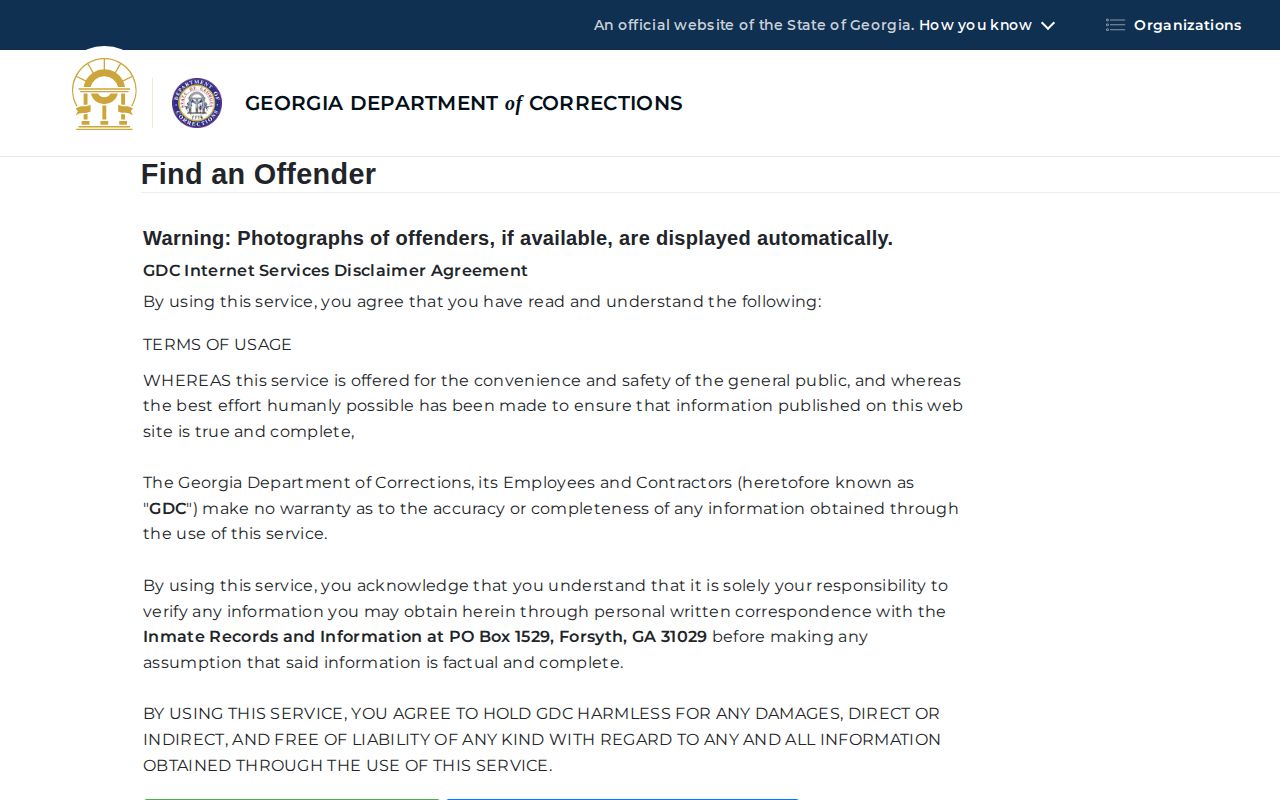
The form belongs to the state-prison path. It does not replace Newton County's jail search for a person held only on a local case. After opening a result, compare the listed identity, status, facility, offense, sentence, and date fields with the known Newton County case.
| Field | How to read it |
|---|---|
| Status | Distinguishes current state custody from a past or released state record when shown. |
| Facility | Identifies the state placement, not the Newton County Jail. |
| Sentence information | Provides the state sentence context behind a computed date. |
| Release or end date | A state record field that may change with lawful recalculation. |
| Case or ID | Helps separate people with similar names and connect the result to a court matter. |
When no state result fits, return to the county jail and court sources. Absence from GDC does not establish a local release, just as absence from the current jail list does not prove that the person entered the community.
The Newton County jail search offers one more useful distinction. “Current Inmates” addresses who is held now, while the previous-inmate option can surface an older booking. Neither is labeled as a sentence calculator. If a person left on bond, the court record may show the bond action even though no projected sentence date ever existed. If a person completed a local term, the sheriff's release record is the direct proof of when jail custody ended.
Older or restricted records may also be absent from ordinary public search. Georgia record restriction under O.C.G.A. § 35-3-37 can limit access to qualifying criminal history and related jail records after the required process. A missing prior record should not be converted into a date estimate. Use the court or agency custodian to determine whether a releasable record exists.
Finally, separate release from supervision. A person can leave prison and begin parole, or leave court under probation terms. Parole is supervised release from a prison sentence; probation is a court-ordered community sentence or condition. The DCS Covington Field Office serves Newton County for felony probation and parole supervision. Its record may help confirm the post-release stage, but it does not replace the jail or GDC record of the actual custody exit.